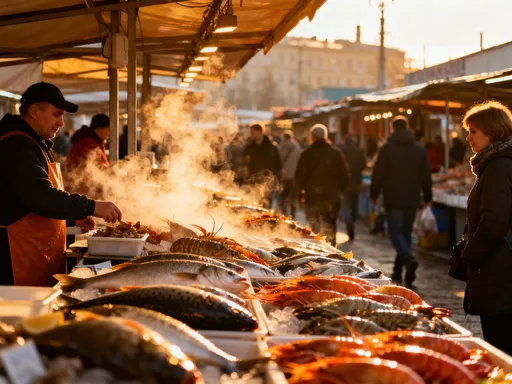
Taste of the Nile: What Khartoum’s Street Food Taught Me About Real Sudan
You know that feeling when you taste something so simple, yet it hits different? That’s Khartoum’s food scene—humble, bold, and full of soul. I didn’t expect to fall in love with a city through its street stalls, but here we are. From sizzling *ful medames* at dawn to spicy *kofta* tucked in warm *kisra*, every bite tells a story of resilience and warmth. In a world where travel often means chasing the spectacular, Khartoum offers something quieter but far more profound: a cuisine rooted in daily life, shared without pretense, and deeply tied to identity. This is not food designed for Instagram—it’s food meant to nourish, to gather, to endure.
First Impressions: Khartoum’s Culinary Rhythm
Arriving in Khartoum just before sunrise, the first thing that greets you is not the heat—though it comes quickly—but the scent. It rises from street corners and open-air kitchens: a blend of cumin, wood smoke, and slow-cooked legumes simmering through the night. The city awakens with a quiet urgency, and nowhere is this more evident than in its food culture. By six in the morning, small clusters of people gather around metal carts and roadside grills, wrapped in light scarves against the early chill, cups of steaming tea in hand. These are not hurried meals but moments of pause, of connection, of grounding before the day unfolds.
The rhythm of Khartoum’s streets is dictated by food. Vendors set up before dawn, their stations simple but efficient: a pot of beans, a stack of flatbreads, a tray of spices arranged in small glass jars. The markets—like Souq Arabi and smaller neighborhood hubs—pulse with life as women in colorful *thobes* barter for vegetables, while men queue for grilled meat wrapped in soft bread. There is no separation between commerce and cuisine; they are interwoven, each reinforcing the other. What stands out is not the extravagance but the consistency—the way food appears at every turn, not as an afterthought but as a central pillar of daily existence.
Food in Khartoum functions as a cultural anchor. In a country shaped by complex histories and shifting political landscapes, the kitchen remains a place of stability. Meals follow predictable patterns, passed down through generations, offering comfort in their familiarity. Even in the city’s busiest districts, where traffic hums and construction rises, the aroma of garlic and coriander oil pulls people toward shared tables. It is here, in these unassuming moments, that one begins to understand Sudan not through headlines, but through hunger, through the act of eating together.
There is also a deep sense of community in how Khartoum eats. Families gather on low stools outside homes, sharing platters from nearby vendors. Strangers sit side by side at plastic tables, passing bread without hesitation. The city does not eat in isolation; it eats collectively. This communal rhythm—eating early, eating simply, eating together—reflects a value system where nourishment extends beyond the body to include belonging and care. For the traveler, this openness is both disarming and transformative.
Breakfast Like a Local: Ful Medames and Beyond
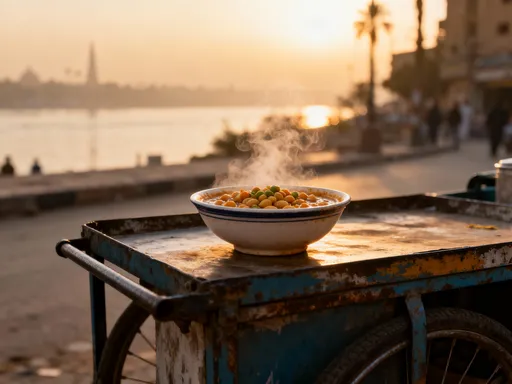
If there is one dish that defines the Sudanese morning, it is *ful medames*—a humble yet deeply satisfying stew of fava beans slow-cooked for hours with garlic, lemon juice, chili, and a generous drizzle of olive oil. Found at nearly every street corner in Khartoum, it is more than a breakfast staple; it is a ritual, a symbol of continuity, and for many, a daily act of resilience. The preparation is deceptively simple, but the mastery lies in the details: the texture of the beans, the balance of spice, the temperature of the oil when it hits the surface. Each vendor has their own variation, a fingerprint of flavor passed down through practice rather than recipe.
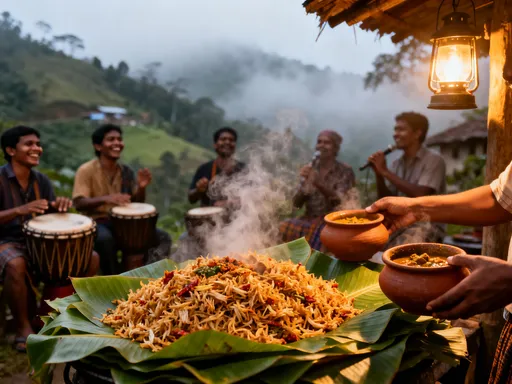
Street vendors often begin cooking *ful medames* late at night, allowing the beans to simmer gently until dawn. They use wide, dented pots that have seen decades of use, their surfaces darkened by fire and time. When served, the beans are scooped into shallow bowls, topped with chopped tomatoes, onions, and hard-boiled eggs, then flanked by wedges of bread. Some add a sprinkle of *dukkah*, a nut and spice blend, while others favor a sharper kick of green chili. What remains constant is the warmth—not just of the food, but of the exchange between vendor and customer, often conducted with little more than a nod or a smile.
For Sudanese families, *ful medames* is more than sustenance; it is identity. It connects the present to centuries of Nubian and Arab culinary traditions, where legumes were a reliable source of protein in arid climates. It is eaten by laborers and professionals alike, bridging social divides with every bite. During religious observances like Ramadan, it becomes even more significant, serving as a grounding first meal after fasting. To eat *ful medames* in Khartoum is to participate in a quiet act of cultural preservation—one that does not require fanfare, only presence.
For visitors, the most authentic versions are typically found in residential neighborhoods or near local markets, away from tourist pathways. These are places where regulars know the vendor by name, where the bread is delivered fresh each morning, and where the tea is brewed strong and served in small glass cups. There are no signs or menus—just the scent of garlic oil and the sound of spoons scraping against ceramic. To find it, one must be willing to wander, to observe, and to accept an invitation when offered. The reward is not just a meal, but a moment of genuine inclusion.
The Art of Bread: Kisra, Aish, and Homemade Traditions
No Sudanese meal is complete without bread, and in Khartoum, bread is not an afterthought—it is a foundation. The most distinctive of these is *kisra*, a sourdough-like flatbread made from sorghum flour, fermented overnight, and poured onto a hot griddle in thin, crepe-like layers. Its texture is uniquely porous, perfect for soaking up stews and sauces, while its slightly tangy flavor speaks to the agricultural roots of Sudan’s interior regions. Unlike wheat-based breads, *kisra* reflects the resilience of crops that thrive in dry, hot climates, making it both practical and symbolic of regional pride.
Another staple is *aish*, a dense, round loaf baked in communal ovens or over open flames. Often used to scoop food or wrap grilled meats, *aish* is a testament to the ingenuity of resourceful cooking—filling, portable, and capable of feeding many. In homes, bread-making is often a family affair, with women preparing large batches in the early morning, their hands moving with practiced ease. The process is slow and deliberate, a rhythm passed from mother to daughter, tied not just to nourishment but to care and continuity.
While street vendors offer convenient access to bread, there is a noticeable difference in texture and flavor between commercial and homemade versions. Street-sold *kisra* tends to be thinner and crispier, optimized for quick service, while home versions are often softer, with a deeper fermentation that enhances their complexity. This contrast reveals a broader truth about Sudanese food culture: the highest quality is rarely found behind glass counters or in glossy restaurants, but in kitchens where recipes are unmeasured and hospitality is automatic.
Sharing bread in Sudan is more than a meal—it is a gesture of trust and welcome. It is common for hosts to break off a piece of *kisra* and place it directly into a guest’s bowl, a small act that signifies inclusion. In a culture where generosity is woven into social etiquette, refusing food can be seen as a rejection of connection. To accept bread is to accept belonging. For travelers, this custom can feel overwhelming at first, but it quickly becomes one of the most meaningful aspects of the experience—a reminder that food, in its purest form, is a language of its own.
Lunchtime Fire: Grilled Meats and Spice Blends That Sing
As the sun climbs higher over Khartoum, the scent of charcoal smoke intensifies, signaling the start of lunchtime grilling. Open-air eateries come alive with the sizzle of skewers, the rhythmic pounding of meat being shaped into *kofta*, and the occasional flare-up of fat hitting hot coals. This is the heart of Sudanese midday dining—simple, fiery, and deeply flavorful. Grilled meats, particularly lamb and beef *kofta*, are central to the meal, often served wrapped in *aish* or alongside a bowl of stewed vegetables and *kisra*.
The magic of Sudanese grilling lies in its spice blends. While cumin and coriander form the base, the true character comes from ginger, cinnamon, and sometimes cardamom, combined into a mix known locally as *hawaij*. This blend varies by region and household, with some favoring heat, others warmth, and still others a subtle sweetness. Marinades are typically left to penetrate the meat for several hours, allowing the flavors to deepen before the brief, high-heat sear. The result is meat that is charred on the outside, tender within, and perfumed with layers of spice that linger on the palate.
Observing a family-run grill in a quiet neighborhood, one notices the precision behind the apparent chaos. The cook moves between multiple tasks—turning skewers, adjusting airflow in the grill, preparing bread—all without haste. Customers arrive in waves, some ordering by name, others pointing to what’s already cooking. There is no menu, no rush, no pretense. The focus is on consistency, on delivering a meal that feels like home. These spaces are not designed for spectacle; they exist to serve, to sustain, to connect.
Spice levels, too, reflect personal and regional identities. In Khartoum, heat is often balanced rather than overwhelming—chili is used to enhance, not dominate. A well-seasoned *kofta* should make you pause, not recoil. For visitors, this offers a gentle introduction to bold flavors, one that encourages exploration rather than endurance. The grills of Khartoum are not about proving tolerance for spice; they are about harmony, about creating a meal that satisfies both body and spirit.
Sweet Endings: Dates, Kahk, and the Ritual of Tea
No meal in Khartoum ends without sweetness, and no sweetness is more cherished than the date. Often served fresh or stuffed with nuts, dates are more than dessert—they are a symbol of hospitality, deeply rooted in Islamic tradition and desert survival. Placed in a small dish at the center of the table, they invite guests to linger, to slow down, to accept the gift of time. Alongside them, one might find *kahk*, a powdered cookie made from semolina, butter, and sugar, sometimes dusted with coconut or cardamom. These delicate sweets appear during celebrations, religious holidays, and family gatherings, their richness balanced by the bitterness of strong tea.
Tea in Sudan is an art form. Brewed slowly in a *ibrick*—a small copper pot—it is made with black tea leaves, sugar, and often spices like cinnamon or ginger. The process is deliberate: the tea is boiled, poured, reboiled, and poured again, each round deepening the flavor and reducing bitterness. It is served in small glasses, often with a froth on top, and always hot. The ritual of serving tea follows a pattern—three rounds, each with its own mood. The first is strong and bold, meant to awaken. The second is smoother, encouraging conversation. The third is sweet and calming, signaling closure.
This ritual is not merely about taste; it is about relationship. To share tea is to share time. In homes and on street corners alike, the pouring of tea marks a transition—from business to friendship, from stranger to guest. It is common for hosts to insist on refills, not out of obligation, but out of genuine desire for connection. For travelers, this practice can be both surprising and deeply moving—a reminder that in many parts of the world, hospitality is not a service, but a responsibility.
The combination of dates, *kahk*, and tea creates a sensory finale that lingers long after the meal ends. It is not indulgent in the Western sense, but balanced—sweetness tempered by spice, richness offset by heat. More importantly, it reflects a philosophy of eating that values conclusion as much as beginning. In a culture where meals are events, not transactions, the ending is just as important as the first bite.
Hidden Corners: Off-the-Beaten-Path Eats and Local Trust
Some of the most memorable meals in Khartoum are not found in markets or on main roads, but in quiet residential neighborhoods where tourists rarely venture. These are places where food is not performed for an audience but lived as part of daily rhythm. To access them, one must rely on local guidance—friends, drivers, or shopkeepers willing to say, “Come, I’ll take you somewhere good.” These invitations are not casual; they are acts of trust, extensions of kinship offered to outsiders.
In one such neighborhood, a small courtyard opens into an informal dining space—low tables, plastic chairs, a single grill glowing in the corner. There is no sign, no menu, just a woman in a bright *thobe* who nods and begins preparing *ful* and *kisra*. The food arrives quickly, served on disposable plates, yet everything feels intentional. The beans are creamier than any found downtown, the bread fermented longer, the oil sharper. This is not a restaurant; it is someone’s home, operating quietly, sustainably, for the community.
These hidden kitchens thrive on word-of-mouth, not advertising. They are known to regulars, to families, to people who value authenticity over convenience. To eat here is to be welcomed into a private world, one where generosity is not monetized but expected. There are no prices listed; payment is often made with a handshake, a smile, or a small envelope handed discreetly. The experience is humbling, a reminder that some of the best things in life cannot be bought—only given.
For travelers, these moments redefine what it means to explore. They shift the focus from seeing to being, from collecting sights to building relationships. In these unmarked spaces, food becomes a bridge—not just between cultures, but between people. It is here, far from guidebooks and reviews, that one begins to understand the true depth of Sudanese hospitality: not as performance, but as practice.
Food as a Bridge: Connecting Culture Through Shared Plates
What becomes clear after weeks in Khartoum is that food here does more than feed. It connects. It disarms. It invites. In a country often misunderstood or overlooked by global narratives, the kitchen offers a different story—one of warmth, resilience, and quiet pride. Meals become conversations, even when words are limited. A shared plate of *ful*, a cup of tea passed hand to hand, a piece of *kisra* broken and offered—these are the moments that dissolve barriers, that turn strangers into guests, and guests into friends.
The universality of food finds its purest expression in Sudanese culture, where generosity is not optional but inherent. To be offered a meal is not a courtesy; it is an expectation, a duty, a joy. This is not cuisine designed for trend or tourism, but for life. It is food that has endured drought, displacement, and change, yet remains a source of comfort and continuity. In this, Khartoum’s street food carries a quiet power—one that speaks not through noise, but through nourishment.
And perhaps that is why this city deserves greater attention. Not because it is exotic, but because it is real. Its flavors are not curated for foreign palates but preserved for local hearts. To taste Khartoum is to taste a culture that values presence over performance, community over commerce, and tradition over trend. In an age of fast travel and fleeting experiences, this is a rare and precious thing.
Travel changes you, but food makes you remember how to belong. In Khartoum, I learned to slow down, to accept an invitation, to eat with my hands, to listen more than I spoke. I learned that the deepest connections are not made in museums or monuments, but over shared plates, in the space between bites, in the silence that follows a good meal. I learned that belonging is not about where you’re from, but about who welcomes you.
Khartoum doesn’t shout about its treasures. It whispers them through flavor, through the quiet pride of a woman serving beans from a dented pot, through smoke rising at dusk from a grill near the Nile. This city taught me that the deepest travel moments aren’t found in grand sights—but in shared bites, in slow conversations over tea, in the courage to taste something unknown. And if you ever go, don’t just look. Sit down. Eat. Let the food speak.